5 benefits of hiring a dedicated Swift developer:
- Native performance and new iOS features on day one, built in Swift and SwiftUI rather than through a cross-platform layer.
- Fewer App Store rejections, because a dedicated iOS developer knows the review guidelines, privacy labels and in-app purchase rules.
- Stronger security through correct use of Keychain, biometrics and App Transport Security.
- Continuity: one person who knows your codebase, so fixes and features ship faster than with rotating freelancers.
- Predictable cost: a fixed monthly rate instead of open-ended hourly billing.
See iOS app development or hire dedicated mobile developers.
The dedicated developer skills that matter most for app development in 2026 are AI-assisted coding with proper review discipline, cross-platform delivery in Flutter or React Native, mobile security aligned to the OWASP Mobile Top 10, API and cloud integration, store compliance, performance engineering, and the communication skills that keep a distributed team aligned.
That list looks different from the one most companies were hiring against three years ago. Two things changed it. AI moved from novelty to default tooling, and the app stores tightened their release requirements to the point where compliance is now a scheduling risk rather than a checkbox.
This guide breaks down the skills that actually separate a productive dedicated developer from an expensive one, how those skills differ by role, and how to test for them before you sign an engagement.
What “dedicated developer skills” means in 2026
A dedicated developer is an engineer assigned full-time to your product rather than split across a queue of client projects. The model only pays off when that person brings judgement, not just throughput. Anyone can now generate a screen full of working code in seconds. The value sits in knowing which code to keep.
So the skill profile has shifted upward. Employers are hiring less for raw syntax knowledge and more for the ability to review, integrate, secure and ship. The sections below follow that order, because that is roughly the order in which weak skills cause damage on a real project.
Core engineering skills that still decide quality
Before anything AI-related, the fundamentals still carry the project. These are the skills that make the difference between an app that survives its second year and one that gets rewritten.
Language and platform depth
Native work still demands Swift and SwiftUI on iOS, and Kotlin with Jetpack Compose on Android. Cross-platform teams need Dart and Flutter or JavaScript and TypeScript with React Native. Depth matters more than breadth here. A developer who genuinely understands one platform’s lifecycle, threading model and memory behaviour will debug faster than someone with shallow familiarity across four.
Cross-platform delivery judgement
The useful skill is not “knows Flutter”. It is knowing when cross-platform is the right call and when it is not. Apps with heavy device integration, background processing or demanding graphics often still justify native. Content-driven and transactional apps rarely do. A developer who can argue both sides of that decision with reference to your actual feature list is worth more than one who defaults to a favourite framework. Our teams work across Flutter app development and React Native app development, and the framework choice is made per project rather than by preference.
API and backend integration
Most app defects trace back to the seam between client and server. Developers need to be comfortable with REST and GraphQL, token-based authentication, retry and offline behaviour, pagination, and versioning. They should also be able to read a backend contract critically and push back when it will cause problems on a mobile client. This is a core part of any API development and integration engagement.
Version control and CI/CD
Branching strategy, meaningful commits, code review participation and automated pipelines. On a dedicated team this is not optional hygiene. It is what allows several engineers to work on one codebase without stepping on each other.
AI-era skills: the biggest shift in the profile
AI tooling is no longer a differentiator on a CV. It is the baseline. In the 2025 Stack Overflow Developer Survey, 84% of respondents were using or planning to use AI tools in their development process, up from 76% the year before. Google’s 2025 DORA research put the figure even higher, with 90% of respondents using AI at work.
What separates developers now is what happens after the code is generated. The same Stack Overflow data is blunt about the problem: only 3.1% of developers highly trust the accuracy of AI output, 66% cite “solutions that are almost right, but not quite” as their top frustration, and 45.2% say debugging AI-generated code takes more time than expected.
The DORA report reached a similar conclusion from the delivery side. AI adoption correlated positively with throughput, but negatively with software delivery stability. The report’s framing is that AI acts as an amplifier, magnifying whatever strengths and weaknesses an organisation already has.
That gives you a clear thing to assess. The skills that matter are:
- Review discipline. Reading generated code with the same scepticism applied to a junior developer’s pull request, rather than accepting it because it compiles.
- Prompt and context engineering. Supplying the model with the right architecture, constraints and existing patterns so the output fits the codebase.
- Test coverage instinct. Knowing that faster code generation makes automated testing more important, not less. This is precisely where the stability problem shows up.
- Knowing when to switch it off. Security-sensitive logic, unusual algorithms and anything touching payments or personal data generally deserve hand-written code and a human reviewer.
Separate from using AI tools, there is the skill of building AI features into an app: integrating LLM APIs, handling streaming responses, managing token cost, designing fallbacks for model failure, and setting realistic accuracy expectations with stakeholders. That is a distinct discipline, and it is what our AI and ML engineers are engaged for. We covered how to evaluate that skill set in more depth in our guide to hiring the best AI developers.
Store compliance: the skill that quietly breaks release dates
This one is underrated and it costs real money. Google Play now enforces target API level requirements with hard deadlines. As of 31 August 2026, new apps and updates must target Android 16 (API level 36) or higher, with Wear OS and Android Automotive on API 35 and Android TV and XR on API 34. Existing apps that fall behind stop being available to new users on newer devices. Extensions can be requested to 1 November 2026, but they are a reprieve, not a plan.
Apple runs an equivalent cadence through SDK requirements, privacy manifests and declared reasons for restricted API use. A developer who tracks these changes proactively will flag them a quarter ahead. One who does not will surface them the week your release is due.
When you assess a dedicated developer or team, ask directly how they monitor platform deprecations and who owns that in their process. A vague answer is a warning sign.
Security and privacy skills
Mobile security has its own threat model, and general web security knowledge does not transfer cleanly. The reference point is the OWASP Mobile Top 10, updated in 2024, which now leads with Improper Credential Usage and Inadequate Supply Chain Security.
Practical skills to look for:
- Secure credential handling, with no secrets or API keys embedded in the client binary
- Correct use of Keychain and Keystore for local storage of sensitive data
- Certificate pinning and correct TLS configuration
- Third-party SDK vetting, since supply chain risk now sits at number two on the list
- Data minimisation and consent handling for GDPR, the Australian Privacy Act, or HIPAA where relevant
- Obfuscation and basic binary protection for apps handling payments or IP
Regulated sectors raise the bar further. Healthcare products in particular need developers who understand compliance as a design constraint rather than a final audit, which is why we treat it as a separate skill set when hiring healthcare software developers.
Architecture, performance and scalability
An app that works with 200 users and collapses at 20,000 is an architecture failure, not a bug. The skills that prevent it are architectural patterns such as MVVM and Clean Architecture, sensible state management, and the discipline to keep business logic out of the UI layer.
Performance work is its own competency. Cold start time, frame rendering, memory footprint, battery consumption and network efficiency all shape retention, and all require profiling tools rather than guesswork. Ask a candidate to describe a performance problem they diagnosed and how they measured the improvement. Developers who have genuinely done this give specific answers quickly.
Cloud fluency belongs here too. Most modern apps depend on managed services for authentication, storage, push notifications and analytics, so a working knowledge of AWS, Google Cloud or Azure is now part of the mobile skill set rather than a separate backend concern.
The non-technical skills that decide outcomes
On dedicated and distributed teams, communication failures cause more delays than technical ones. The skills worth screening for:
- Written clarity. Most coordination happens in tickets, pull requests and asynchronous messages. A developer who writes a clear status update saves hours of meetings.
- Product thinking. Understanding why a feature exists, and being willing to say when a simpler version would serve the user better.
- Estimation honesty. Realistic estimates, with early warning when they slip. Optimism is the most expensive habit in software.
- Timezone overlap discipline. Not the same as availability. It is about structuring work so blocking questions are asked before the overlap window closes.
- Documentation habit. Because the person who inherits the codebase might not be them.
UI and UX collaboration sits in this group as well. Developers do not need to design, but they do need to read a design system accurately and raise implementation constraints early rather than silently approximating.
Skills by role: what to expect from each seat
Not every skill belongs to every developer. On a properly staffed dedicated team, the coverage is distributed:
- Mobile engineer: platform depth, UI implementation, offline behaviour, store release process. See hire mobile engineers.
- Backend engineer: API design, database modelling, authentication, scaling and observability.
- Full-stack developer: broad coverage for smaller teams and MVPs, where a single engineer spans client and server. See hire full-stack developers.
- AI and ML engineer: model integration, evaluation, prompt design, cost and latency management.
- QA engineer: test automation, device matrix coverage, regression strategy. This role gets more important as AI-generated code volume rises.
- DevOps engineer: pipelines, environments, release automation, monitoring.
A common and expensive mistake is hiring three mobile engineers and no QA or DevOps capability, then wondering why releases are slow and unstable.
How to assess these skills before you commit
CV keywords tell you very little now, partly because they are easy to generate. These methods work better:
- Review real code. Ask for a sample from a shipped product and have someone technical read it. Structure, naming and error handling reveal more than any interview answer.
- Run a code review exercise. Give the candidate a flawed pull request, ideally one with plausible AI-generated code containing a subtle bug, and ask what they would change. This tests exactly the judgement the AI era demands.
- Ask for a failure story. A specific production incident, what caused it and what changed afterwards. Vague answers usually mean limited ownership.
- Test the compliance question. Ask how they handled the most recent platform requirement change. Preparedness shows immediately.
- Start with a paid trial sprint. Two weeks of real work tells you more than any interview process, and it is cheap compared with a bad six-month engagement.
If you are working through a partner rather than hiring directly, our guides to hiring mobile app developers and choosing an IT staff augmentation partner cover the commercial and contractual side in detail.
Dedicated team, freelancers or in-house?
The skills above are the same whichever model you choose. What changes is how reliably you get them.
An in-house team gives you the tightest alignment with company context, and costs the most to build and retain. Freelancers are flexible and suit contained pieces of work, but coverage across security, QA and DevOps is usually thin, and availability varies. A dedicated team sits between the two: full-time focus on your product, a broader skill mix than any individual can offer, and the ability to scale the team up or down as the roadmap changes.
The honest caveat is that the dedicated model depends heavily on the partner. A weak partner supplies bodies rather than skills, rotates people without warning, and leaves the compliance and QA gaps described above unfilled. Assess the individuals, not just the agency. Our app development outsourcing guide goes through the trade-offs for smaller companies specifically.
Frequently asked questions
What are the most important skills for an app developer in 2026?
Platform depth in Swift, Kotlin, Flutter or React Native; API and cloud integration; mobile security aligned to the OWASP Mobile Top 10; store compliance awareness; performance profiling; and the review discipline to work safely with AI-generated code. Communication and estimation honesty matter as much as any of these on a distributed team.
Do app developers still need to write code themselves now that AI can generate it?
Yes. Stack Overflow’s 2025 survey found only 3.1% of developers highly trust AI output accuracy, and 66% named “almost right, but not quite” solutions as their top frustration. Generation is fast; judging, correcting and securing the result still requires an engineer who could have written it.
Should I hire native or cross-platform developers?
It depends on the app. Heavy device integration, background processing or demanding graphics often justify native. Content-driven and transactional apps are usually well served by Flutter or React Native, with one codebase and a smaller team. Choose the framework after defining the feature set, not before.
How many developers does a typical dedicated app team need?
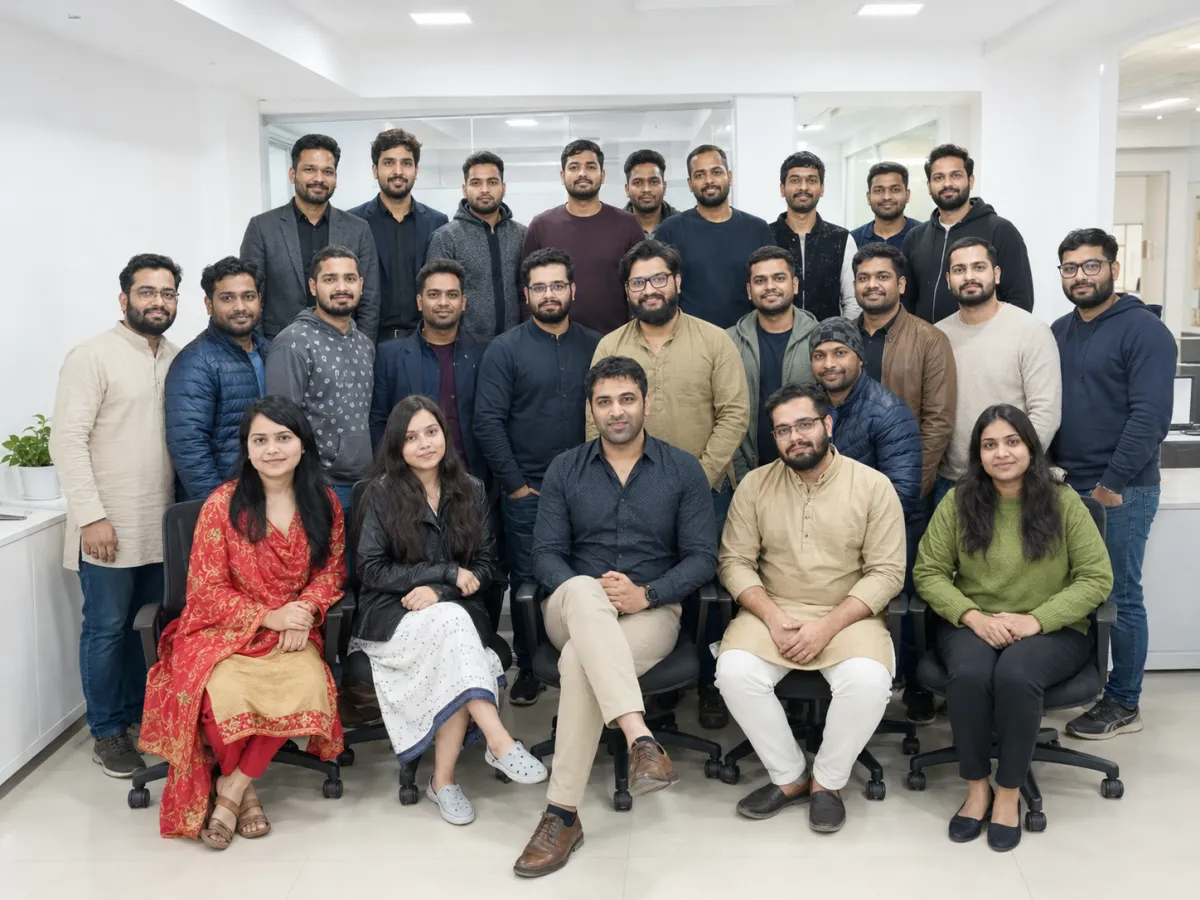
A functional team for a mid-sized product is usually four to six people: one or two mobile engineers, a backend engineer, a QA engineer, part-time DevOps, and a project or product lead. Smaller MVPs can run on two to three with a full-stack developer covering more ground.
How do I check whether a developer’s security skills are real?
Ask how they store API keys and tokens, how they vet third-party SDKs, and what they would change about a client that stores a session token in plain preferences. Specific, immediate answers indicate genuine practice. General statements about “following best practices” usually do not.
What is the risk of hiring on skills alone?
Skill coverage without team structure still fails. Teams that add engineering capacity without QA, DevOps or release ownership tend to ship faster and break more, which matches DORA’s 2025 finding that AI adoption improves throughput while putting pressure on delivery stability.
Bringing it together
The skill list for app development has not simply grown longer. It has moved up a level. Writing code is faster than it has ever been, which means the scarce skills are now review, security, compliance and architectural judgement. Those are the abilities that keep an app stable while it grows, and they are the ones worth testing hardest before you commit to a team.
If you are assembling a team for a new build or strengthening an existing one, Appther provides dedicated developers across mobile app development, backend, AI and QA, engaged full-time on your product. Talk to our team about the skill mix your roadmap actually needs.