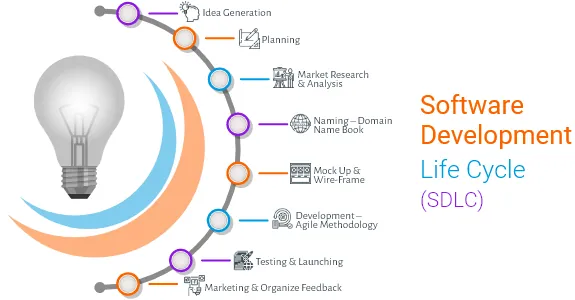
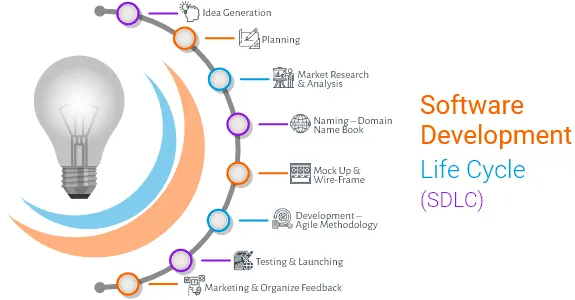
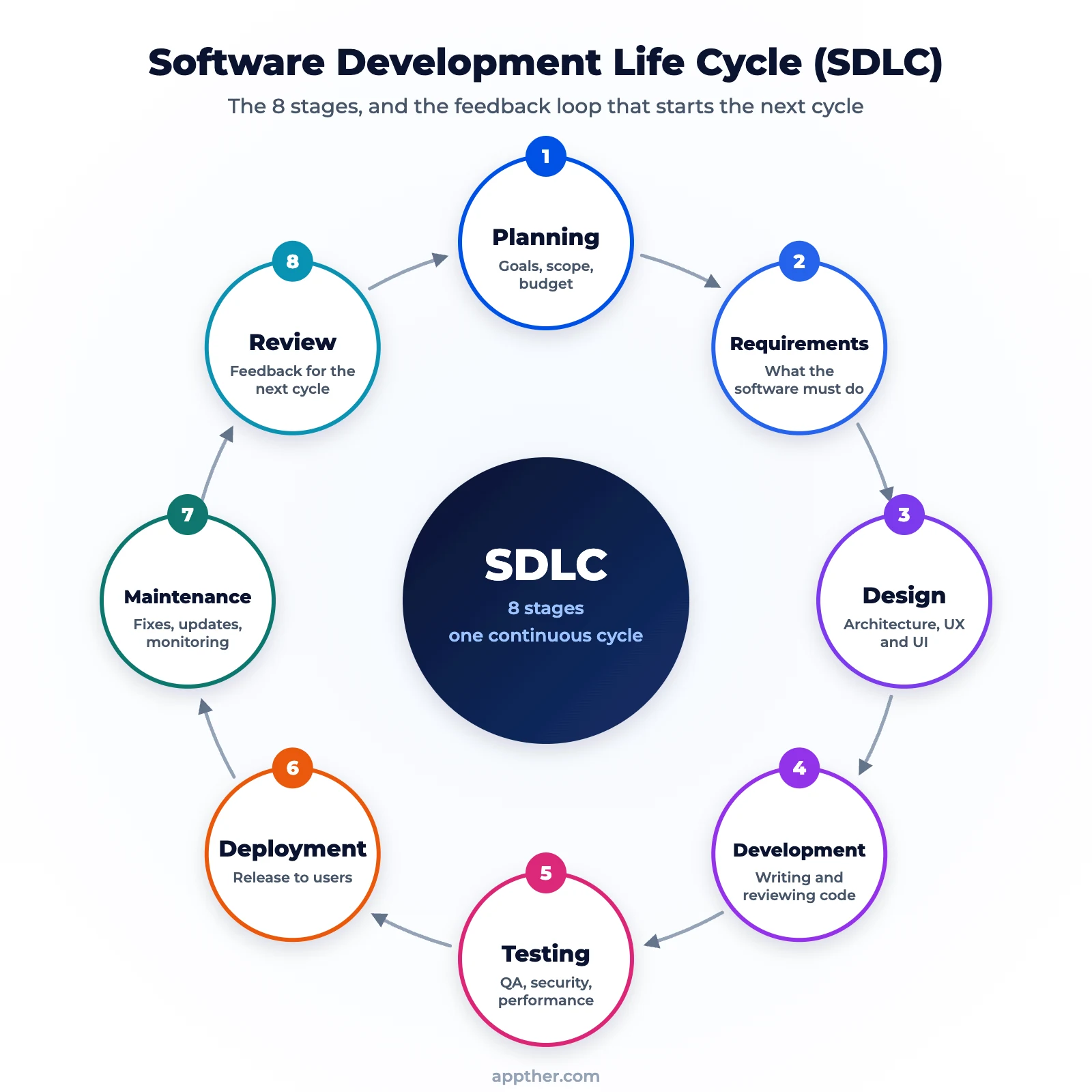
Short answer: the software development life cycle (SDLC) is the process teams follow to turn an idea into working software and keep it running. It has 8 stages: planning, requirements, design, development, testing, deployment, maintenance and review. The review feeds the next round of planning, which is why the SDLC is drawn as a cycle.
What is the software development life cycle?
The SDLC is a structured way to plan, build, test and run software. It breaks a large, uncertain project into stages with clear goals and outputs, so everyone knows what is being decided now and what comes next.
Without it, projects tend to fail in predictable ways: features get built before anyone agreed what they were for, testing gets squeezed into the last week, and nobody owns the software once it goes live. A good SDLC prevents all three. It does not have to be heavy. A two-person startup and a bank follow the same stages; they just spend different amounts of time in each.
The 8 stages of the SDLC
1. Planning
Planning answers why the software should exist and whether it is worth building. The team agrees the business goal, the audience, a rough scope, the budget and the timeline, and names the risks that could derail the project.
Output: a project brief or roadmap with success measures written down. Common mistake: skipping the success measures, which makes it impossible to tell later whether the project worked.
2. Requirements analysis
This stage turns the goal into specifics: what users need to do, what the system must do in response, and the constraints it has to respect, such as security, performance, regulations and the systems it must connect to.
Output: a requirements document or a prioritised backlog of user stories with acceptance criteria. Common mistake: writing requirements without talking to the people who will use the software.
3. Design
Design decides how the software will meet those requirements. It covers the architecture (how the system is split into parts and where it runs), the data model, integrations, security, and the user experience, usually tested first as a clickable prototype.
Output: architecture diagrams, a design system and an approved prototype. Choices made here are expensive to change later, for example whether to build a monolith or microservices.
4. Development
Developers write the code, usually in short iterations. Every change is reviewed by another engineer and merged into a shared codebase, where automated builds check that nothing broke. This is the longest stage, but it goes fastest when the earlier stages were done well.
Output: working, reviewed code in a staging environment the client can try. Common mistake: starting here and treating planning and design as optional.
5. Testing
Testing confirms the software does what the requirements say and fails safely when it does not. It includes functional testing, testing on real devices and browsers, performance and load testing, security testing and user acceptance testing with real users.
Output: a tested release candidate and a record of known issues. Testing works best when it runs throughout development, not only at the end.
6. Deployment
The software is released to users: published to the app stores, deployed to production servers, or rolled out to a company’s staff. Careful teams release in stages, watch the numbers, and keep a tested way to roll back.
Output: live software, monitoring dashboards and release notes.
7. Maintenance
Once software is live, it needs care: bug fixes, security patches, operating system and library updates, performance tuning and support for users. For most products this stage lasts far longer than the build. A useful rule of thumb is to budget 15 to 20 percent of the build cost each year for maintenance.
Output: a stable, secure product and a log of issues and fixes.
8. Review and feedback
The team measures the live software against the success measures set in planning, gathers user feedback and analytics, and decides what to improve, add or remove next. Those decisions become the input for the next planning stage, which is what makes the SDLC a cycle.
Output: a prioritised list of improvements for the next cycle.
SDLC stages at a glance
| Stage | Key question | Main output |
|---|---|---|
| 1. Planning | Why build this, and is it worth it? | Brief, roadmap, success measures |
| 2. Requirements | What exactly must it do? | Requirements or prioritised backlog |
| 3. Design | How will it work and look? | Architecture, data model, prototype |
| 4. Development | Is the code built and reviewed? | Working software in staging |
| 5. Testing | Does it work, safely and at scale? | Tested release candidate |
| 6. Deployment | Can users get it reliably? | Live release, monitoring |
| 7. Maintenance | Is it staying secure and stable? | Fixes, updates, support |
| 8. Review | Did it work, and what is next? | Improvements for the next cycle |
SDLC models: Waterfall, Agile and others
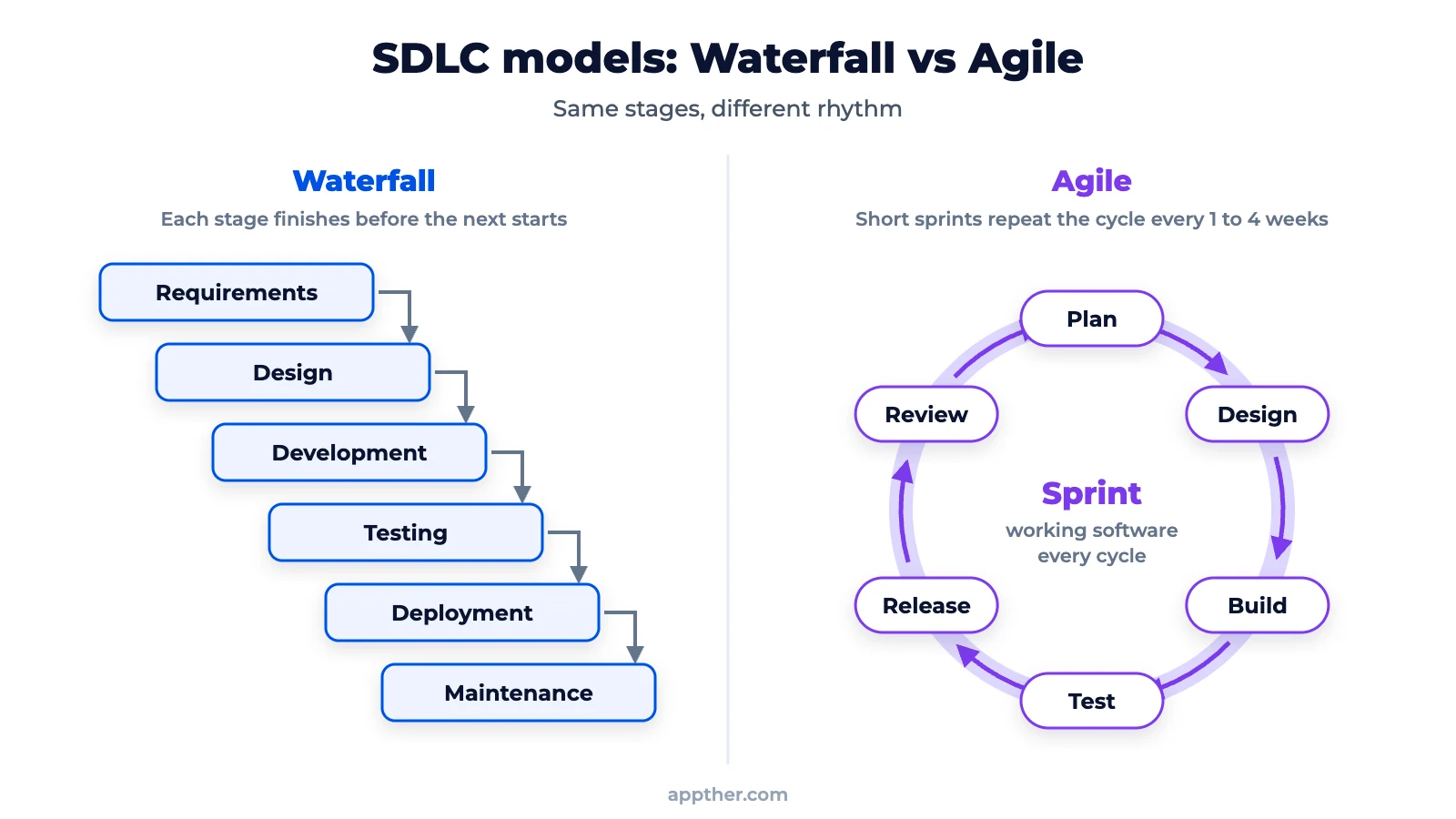
Every SDLC model uses the same stages. What changes is the rhythm: whether you move through them once, in order, or many times in small loops.
| Model | How it works | Best for |
|---|---|---|
| Waterfall | Each stage is finished and signed off before the next begins | Fixed, well-understood requirements; regulated projects |
| Agile (Scrum, Kanban) | Short sprints of one to four weeks, each delivering working software | Most products, especially when requirements will change |
| Iterative | Build a basic version, then improve it in repeated cycles | Large systems that can grow in steps |
| Spiral | Repeated cycles with a formal risk review in each | High-risk, high-budget projects |
| V-model | Waterfall with a matching test stage for every build stage | Safety-critical and compliance-heavy software |
| DevOps | Development and operations share ownership, with automated testing and frequent releases | Products that ship updates often |
In practice most teams in 2026 use a hybrid: a short upfront planning and design phase, then Agile sprints for development and testing, with DevOps practices for deployment and maintenance.
Benefits of following an SDLC
- Predictable cost and timeline: scope and estimates are agreed before the expensive work starts.
- Fewer surprises: risks are named early, while they are still cheap to deal with.
- Better quality: testing and code review are built into the process rather than added at the end.
- Clear ownership: everyone knows which decisions belong to which stage.
- Software that lasts: maintenance and review are planned from day one, not discovered after launch.
Security in the SDLC
Security is cheapest to build in early. A secure SDLC adds threat modelling during design, secure coding standards and dependency checks during development, security testing before release, and patching during maintenance. The US National Institute of Standards and Technology describes these practices in its Secure Software Development Framework, a useful checklist for any team.
How AI is changing the SDLC in 2026
AI coding assistants now help at almost every stage: summarising requirements, suggesting designs, writing and reviewing code, generating tests and spotting issues in production logs. Used well, they shorten development and testing. They do not remove the need for the stages themselves. Someone still has to decide what to build, check that AI-written code is correct and secure, and own the software after launch.
How Appther runs the SDLC on client projects
At Appther every project follows these stages in a milestone-driven way. We start with discovery and written success measures, share a clickable prototype before development, build in two-week sprints with a live demo at the end of each, test on real devices before launch, and stay on for maintenance and improvements. You can see the process in our case studies, or read about our custom software development and mobile app development services.
Frequently asked questions
What are the 8 stages of the SDLC?
Planning, requirements analysis, design, development, testing, deployment, maintenance, and review and feedback. Some sources merge stages and list five, six or seven, but the work covered is the same.
Why is the SDLC drawn as a cycle?
Because software is never really finished. The review of live software produces the plan for the next version, so the last stage leads back to the first.
Which SDLC stage is the most important?
Planning and requirements, because mistakes made there are the most expensive to fix later. A feature built on a wrong requirement has to be redesigned, rebuilt and retested.
What is the difference between the SDLC and Agile?
The SDLC is the set of stages every software project goes through. Agile is one way of moving through them, in short repeated sprints rather than one long sequence.
How long does the software development life cycle take?
A focused app MVP typically takes 8 to 12 weeks from planning to launch, and a full product three to six months. Maintenance and review then continue for as long as the software is in use.
Plan your next project with Appther
Have an idea and want to know what each stage would involve, how long it would take and what it would cost? Talk to our team and we will send a written plan with the timeline and a fixed price.